





The Problem Nobody Admits
Everyone is talking about AI agents Explained.
But most explanations sound like this:
“An autonomous AI system that orchestrates multi-step reasoning using LLMs with tool invocation and memory persistence…”
Yeah. No one learns anything from that.
So let’s do this properly — human-first, jargon-free, and still technically correct.
First: What an AI Agent Is (In Plain English)
An AI agent is simply:
An AI that can think, decide, and act — repeatedly — to achieve a goal.
Unlike a normal AI prompt:
❌ You ask once → get one answer → done
An AI agent:
- Understands a goal
- Breaks it into steps
- Uses tools (APIs, files, browsers, code)
- Remembers what happened
- Adjusts based on results
Think of it like a junior employee, not a chatbot.
Chatbot vs AI Agent (Quick Comparison)
| Feature | Chatbot | AI Agent |
|---|---|---|
| Single response | ✅ | ❌ |
| Goal-oriented | ❌ | ✅ |
| Uses tools | Limited | Yes |
| Memory | Short-term | Persistent |
| Can retry/fix itself | ❌ | ✅ |
This is why agents feel alive.
The 4 Core Components of an AI Agent
Every AI agent — no matter how fancy — has four building blocks.
1️⃣ The Brain (LLM)
This is the reasoning engine.
Examples:
- GPT
- Claude
- LLaMA
- Mistral
It decides:
- What to do next
- Which tool to use
- When the task is complete
👉 No magic. Just probability + logic.
2️⃣ The Goal (Instructions)
Agents don’t “think freely”.
They follow clear objectives, like:
- “Find trending AI tools and summarize them”
- “Monitor job postings and alert me”
- “Build a resume tailored to each job”
Bad goals = bad agents.
3️⃣ Tools (Hands & Legs)
This is where agents become powerful.
Tools can include:
- Web search
- APIs
- Databases
- File systems
- Code execution
- Automation tools (n8n, Zapier, Make)
Without tools, agents are just smart talkers.
4️⃣ Memory (Experience)
Memory lets an agent:
- Remember past actions
- Store results
- Avoid repeating mistakes
Types of memory:
- Short-term (current task)
- Long-term (vector databases, files, logs)
This is why agents improve over time.
How an AI Agent Actually Works (Step-by-Step)
Let’s say the goal is:
“Create a weekly AI tools newsletter.”
Here’s what happens internally:
- Understand the goal
- Plan tasks
- Find new tools
- Rank relevance
- Summarize features
- Use tools
- Browse web
- Extract data
- Evaluate results
- Is content useful?
- Refine output
- Repeat weekly
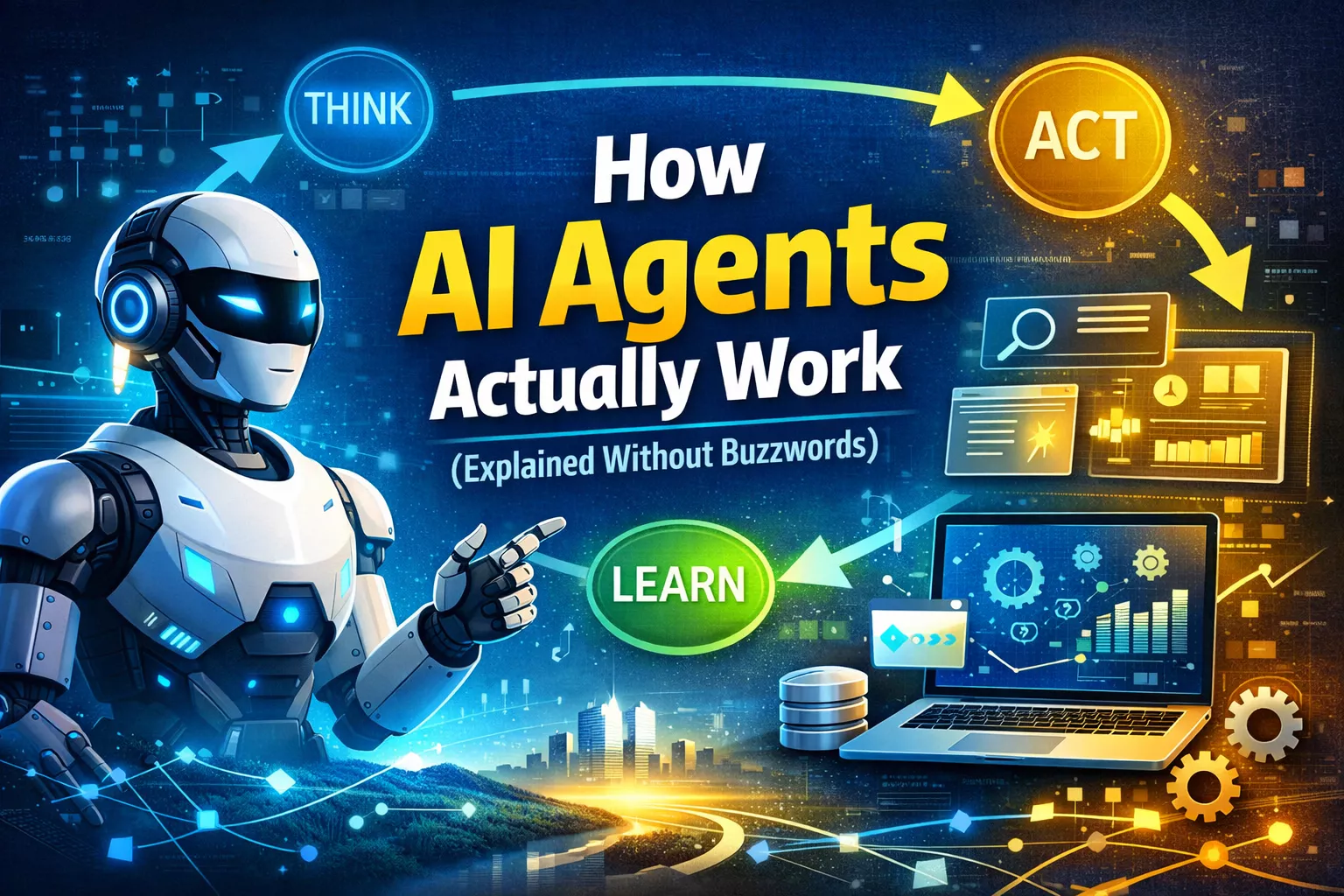
This loop is called the agent cycle:
Think → Act → Observe → Improve
Real-World AI Agents Explained (You’ve Seen These)
You might already be using agents without realizing it:
- 🔍 Auto job appliers
- 🧾 Resume tailoring tools
- 📊 SEO content generators
- 🤖 Customer support bots that escalate smartly
- ⚙️ No-code automations using n8n
They’re not “AGI”.
They’re well-instructed systems.
Why AI Agents Matter in 2025–2026
Here’s the uncomfortable truth:
People who design agents will outperform people who only use tools.
Because agents:
- Scale your time
- Reduce repetitive work
- Turn ideas into systems
This is the shift from:
“Prompting” → “Building workflows”
How You Can Start AI Agents Explained (Without Coding)
You don’t need to be an engineer.
Start with:
- n8n
- Make.com
- OpenAI APIs
- Open-source agents
- Prompt engineering fundamentals
Even a simple agent that:
Reads → summarizes → alerts
…can save hours every week.
Final Thought
AI agents aren’t scary.
They’re amplifiers.
If you understand how they work, you control them.
If you don’t, you’ll keep wondering why others move faster.
And in tech — speed compounds. Follow TeX for more updates.